Unwired
Untethered and Unfettered
The Freedom Imperative
The Ubertrend describing humanity’s migration to a highly independent, mobile lifestyle — driven by smartphones, connected devices, and an emerging culture of control enthusiasm. The chief value impelling people to untether is freedom: the right to decide when and where to use services while seeking greater control over life’s daily interfaces.
Chicago, 1955
The Unwired Ubertrend’s modern arc traces to a nondescript building on Chicago’s West Side in 1955. Inside, Robert Adler, an engineer at Zenith Radio, was working on the company’s latest product: a cordless remote control. His challenge was deceptively narrow — get four aluminum rods to emit a distinct ultrasonic sound the TV’s six-vacuum-tube receiver could decode.
The urgency was real. Months earlier, Zenith president Eugene “The Commander” McDonald had ordered an immediate redesign of the Flash-Matic, the first wireless TV remote, designed by Zenith engineer Eugene Polley. The Flash-Matic resembled a ray gun and used light signals to control four photocells — a system that didn’t work in bright sunlight. Adler’s replacement, the Space Command, was entirely mechanical. A push of the button caused a tiny hammer inside the control to hit an aluminum rod, producing a click. Hence the persistent nickname for remotes: “clicker.”
Polley and Adler were not the first to dream up a remote. Nikola Tesla had wirelessly piloted a four-foot boat at New York’s Electrical Exhibition in Madison Square Garden in 1898. On December 12, 1901, Guglielmo Marconi sent the first radio transmission across the Atlantic Ocean, jump-starting the wireless revolution. The technology’s commercial breakthrough required half a century more. The Space Command shipped in Fall 1956. The bomb cyclone of Unwired — the smartphone and its controlling apps — was still 51 years away.
A coined word, a control freak culture
“Unwired” entered the Ubertrend lexicon as the simple inverse of every cable, every cord, and every binding contract the consumer had inherited from the 20th century. The chief value impelling people to untether was freedom — from wires, and perhaps from relationships. The tentacles of the Unwired Ubertrend have touched lives in unexpected ways. There is the emerging phenomenon of control enthusiasm, which projects the ability to swipe left or right with an app into life.
The supporting cultural diagnosis arrived in The Washington Post on February 6, 2006, when reporter Libby Copeland wrote about “a peculiarly modern… consumeriffic culture in which jeans and houses and breasts and ringtones are customizable.” Copeland called the phenomenon pickiness; the chapter recasts it as a control enthusiast syndrome. Patrick Warburton’s late-2000s National Car Rental ads gave it a slogan: “Control is so — what’s the word — sexy.” The compound condition can be summed up in one bumper-sticker phrase that has spread across the demographic deck: I want it all, and I want it now.
The naked truth, pardon the dating pun, is that the indulgent culture surrounding Unwired has made everyone far more exacting. That power, harbored in the smartphone, has conspired to make most users control freaks. Old-school luxury meant having someone else deal with your luggage. The control enthusiast way is rolling your own wheeled bags. Avoiding humans is part of the repertoire.
The smartphone revolution
The hinge point of Unwired falls on Friday, June 29, 2007, when a long line forms on Stockton Street in San Francisco. It is not a movie premiere or celebrity signing — it is iDay, the line waiting for the first Apple iPhone to go on sale. Some have been camped on the sidewalk for nights. Steve Jobs’s pitch is by now a memorized incantation: “It’s an iPod, a phone, and an internet communicator. An iPod, a phone… are you getting it?”
The early devices were buggy and the software was unfinished. Apple sold 700,000 iPhones the first weekend anyway. BlackBerry co-CEO Jim Balsillie famously dismissed it — “It’s OK, we’ll be fine” — in what would become one of the most-cited “last words” in tech history. By 2018, Apple had become the first company valued at $1 trillion. By Q1 FY2026, Apple reported an active installed base of more than 2.5 billion devices, and its market capitalization reached approximately $4.5 trillion as of May 2026.
The App Store opened thirteen months later, on July 10, 2008, with just 500 apps available. By the end of the launch weekend, 10 million apps had been downloaded. By June 2018, Apple had paid third-party developers $100 billion in software royalties. The expression “there’s an app for that” — trademarked by Apple in 2010 — became operating procedure for the consumer economy.
Bank of America CEO Brian Moynihan named the underlying shift in a 2016 Bloomberg interview: “The intimacy and distributed power of a smartphone in the hands of a person is so different than anything we’ve faced in our business careers.” The Unwired Ubertrend had moved past gadget novelty. It had become the new social contract.
Four engines of untethering
Four engines drive the Unwired flywheel — each measurable, each accelerating since the iPhone. The smartphone has consolidated capture, payment, identity, and attention. The connected home has metastasized into a multi-billion-device IoT graph. Geolocation, drones and autonomous gear have remade mobility. And the control-enthusiast subculture, named by the chapter, has scaled into a default consumer-product expectation.
Driver 01
Smartphone supremacy
Apple’s active device base exceeded 2.5 billion in Q1 FY2026; its market cap reached approximately $4.5 trillion in May 2026. The average U.S. adult now spends 5 hours 1 minute a day on a smartphone and checks it 205 times (Reviews.org, 2025). The global App Store facilitated $1.3 trillion in developer billings and sales in 2024. The pocket has won.
Driver 02
Connected home & IoT
Amazon Echo launched June 23, 2015. By February 2025, Amazon reported more than 600 million Alexa devices in use worldwide. The U.S. smart-home market was estimated at $24 billion in 2024 and $29 billion in 2025, projected to reach $84 billion by 2030 (Grand View Research).
Driver 03
Mobility, drones & geolocation
The connected commercial drone installed base reached 2.8 million units worldwide in 2024, forecast to reach 4.5 million by 2029, with DJI holding approximately 70% global market share (ResearchAndMarkets). GPS-equipped smartphones replaced the paper map; Google Maps passed 2 billion monthly users in 2024. By 2009, 80% of iPhone owners were using turn-by-turn directions.
Driver 04
Control enthusiasm
From Domino’s 2008 pizza-order tracker to the Amazon Dash button (March 31, 2015) to the Nest Learning Thermostat (October 2011) — the consumer has been promoted to dispatcher of every transaction. As early as 2007, UPS processed some 143 million package-tracking requests per day — a proof point that consumer patience had been permanently reset. I want it all, and I want it now has gone from lyric to operating manual.
There’s an app for that
Steve Jobs initially resisted third-party access to the iPhone. His argument was that “the full Safari engine is inside of iPhone, so you can write amazing Web 2.0 and Ajax apps that look exactly like apps on the iPhone.” iPhone rebels who jailbroke their devices to install non-approved software made the argument moot. Twelve months after the iPhone’s retail launch, the App Store made its formal debut.
The mobile economy that followed generated $1.3 trillion in developer billings and sales through the global App Store in 2024 alone — including $131 billion in digital goods and $150 billion in in-app advertising (Apple, June 2025). Yelp launched augmented reality in an app feature called Monocle in 2009. IKEA Place and Amazon’s AR View let users virtually place furniture in real rooms. Google Lens identifies objects, plants, dog breeds and product labels. SkinVision diagnoses suspicious lesions. The smartphone has become the entry point for ancestry analysis (23andMe), genome reading (Veritas Genetics’ original $999 myGenome), augmented reality, voice translation, real-time payments, and identity verification at the airport.
The cultural payload was bigger than the technical payload. Social media apps mobilized the Arab Spring: on January 25, 2011, activists organized Tahrir Square via Facebook and Twitter. Wael Ghonim, a Google marketing manager, became the public face of the protests; one Egyptian man named his newborn daughter “Facebook” in tribute. For Twitter, the mobile inflection point came in 2011, when CEO Dick Costolo reported 55% of active users accessing the service via mobile. By 2013, that figure was 60%; by 2015, 80%. Posting updates with smartphones became the leading cultural transmission belt of the era — FOMO (fear of missing out) the leading psychological consequence.
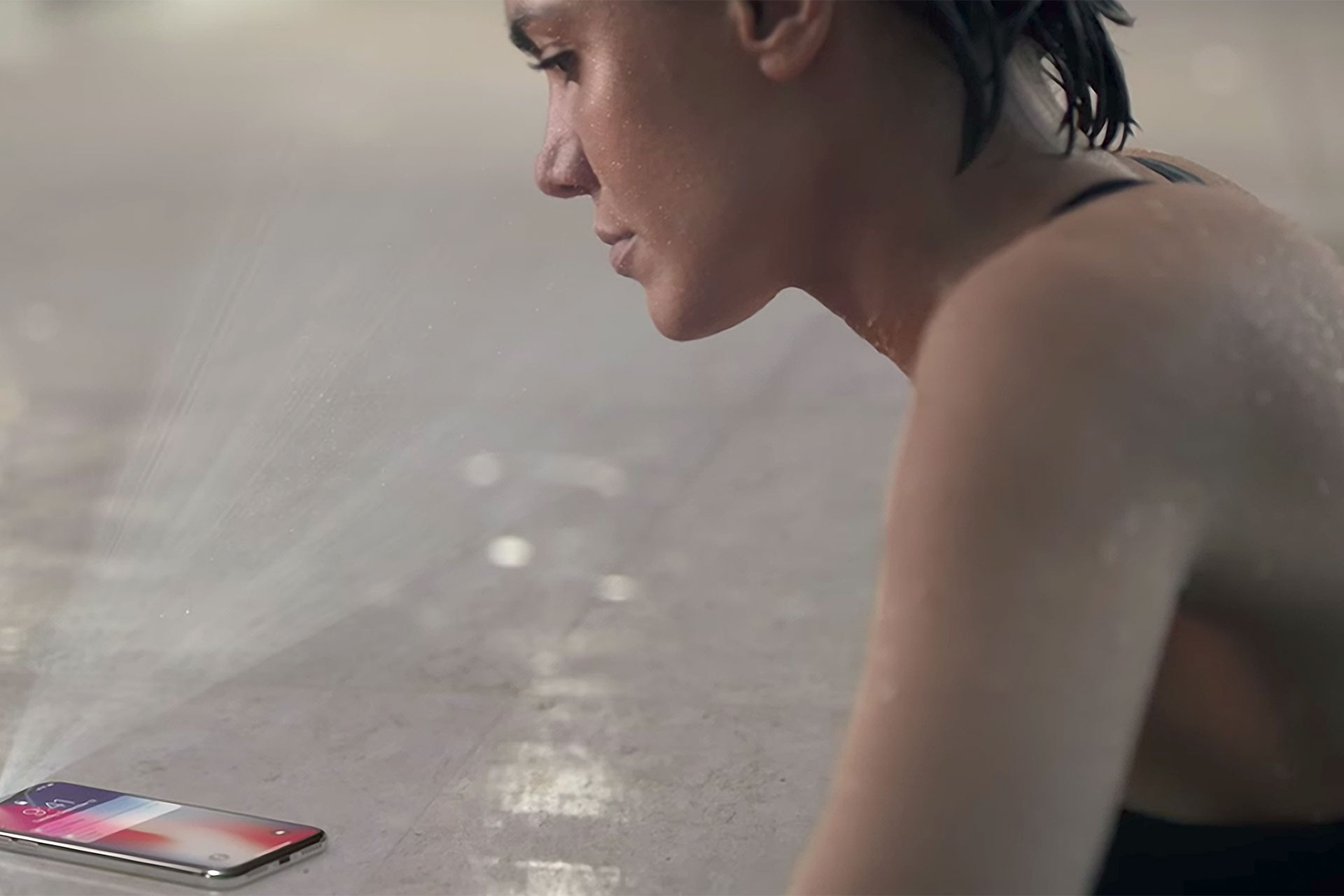
Screensucking, Visualized: Apple Face ID, 2017
Apple unveiled Face ID on the iPhone X in November 2017, replacing Touch ID with TrueDepth infrared facial recognition. The marketing image — a swimmer surfacing only to fix her gaze on the device awaiting her on the pool deck — captured the phenomenon yours truly has long called screensucking: the gravitational pull a phone now exerts on the human face. The technology reads her face. She reads the screen. By 2025 the average American adult spent about 5 hours 1 minute a day on a smartphone and checked it 205 times per day (Reviews.org, 2025). 80.6% check their phones within the first 10 minutes of waking. The pose is no longer marketing. It is operating procedure.
Image courtesy: Apple, iPhone X Face ID advertising campaignFive numbers that frame the untethering
cumulative iPhones sold by Apple as of 2024 (up from 1.4B in 2018)
average daily smartphone use per U.S. adult in 2024 (HostingAdvice)
average phone pickups per day per U.S. adult in 2024 — over 200 by some surveys
global installed base of smart speakers by 2024 (Alexa, Google, HomePod)
U.S. smart home market 2024, projected $90B+ by 2030 (Statista)
A timeline arc
Nikola Tesla wirelessly pilots a four-foot boat at New York’s Electrical Exhibition in Madison Square Garden. The Unwired thesis begins.
December 12 — Marconi’s transatlantic radio transmission. Wireless leaves the lab and becomes industrial infrastructure.
Zenith introduces Lazy Bones, the first TV remote — still tethered by wire. The first untethering attempts begin.
Robert Adler’s Zenith Space Command ships — the first commercially successful wireless TV remote, using ultrasonic clicks.
Motorola’s Martin Cooper places the first cellular phone call from a New York sidewalk to Bell Labs. The pocket era is sketched.
Finland’s Benefon ESC! becomes the first GPS-equipped mobile phone. Location-aware computing arrives in the consumer pocket.
June 29 — iDay. The first iPhone ships. Apple sells 700,000 units the opening weekend.
July 10 — App Store launches with 500 apps. 10M downloads in the first weekend.
Parrot AR.Drone debuts at CES — the consumer drone enters the home as a smartphone-controlled toy.
Arab Spring uprisings — the first mass political mobilization run on smartphone apps. October: Tony Fadell’s Nest Learning Thermostat launches.
June 23 — Amazon launches the Echo speaker with Alexa voice assistant. The connected home gets a default interface.
November — Apple launches the iPhone X with Face ID. The phone now reads the face. Touch ID retires.
Apple crosses $1 trillion in market capitalization — first U.S. public company. Cumulative iPhones sold: 1.4 billion.
Wegovy gets a connected-app twin: by 2022 most major health and metabolic apps talk to Apple Health and Google Fit. The smartphone becomes a medical device.
Apple Intelligence announced at WWDC, June 10. On-device generative AI begins to integrate into the iPhone, iPad and Mac. The next iDay is implied.
The evidence base
Unwired is not one industry but three converging ones — the smartphone economy, the connected-home/IoT mesh, and the mobility platform — each measurable, each on an exponential curve since 2007. Read together, they describe the most consequential consumer technology reorganization since the household telephone.
The smartphone economy is the obvious headline. Apple alone reached a $4.5 trillion market capitalization by May 2026; the global App Store facilitated $1.3 trillion in developer billings and sales in 2024. Pew Research’s 2025 survey found 91% of U.S. adults own a smartphone, up from 35% in 2011. Millennials pick up their phones an average of 324 times daily, the highest of any cohort. The device has consolidated payment (Apple Pay, Google Pay), identity (Face ID, Touch ID), capture (camera), navigation (GPS), translation (Live Translate), and now generative AI (Apple Intelligence, Gemini, Copilot) into a single object.
The connected home is the quieter but larger build. Amazon Alexa alone has crossed 600 million units shipped lifetime; Google and Apple add hundreds of millions more. IoT as a category — from Belkin WeMo (2012) to Philips Hue (2012) to Samsung SmartThings (2012) to Lutron Caseta — has scaled to 18.8 billion connected IoT devices globally in 2024, projected to reach 40 billion by 2030 (IoT Analytics). The Matter standard (launched 2022) is gradually replacing the early walled gardens with cross-vendor interoperability.
The mobility layer is the third force. The connected commercial drone installed base reached 2.8 million units worldwide in 2024, with DJI holding approximately 70% global market share, and is forecast to reach 4.5 million units by 2029 (ResearchAndMarkets). The chapter cites a 2018 Venezuelan assassination attempt using two DJI Matrice 600 drones loaded with explosives. The technology cuts both ways — from drone-shot crop dusting (one South African farmer reports a 30% pesticide reduction) to drone-shot insurgency.
The pocket has won. The face is next.
Apple active device base: 2.5 billion-plus (Q1 FY2026); Apple market cap: approximately $4.5 trillion (May 2026); global App Store developer billings and sales: $1.3 trillion (2024); 91% U.S. smartphone ownership (Pew, 2025). Average daily use: 5 hours 1 minute. Face ID, launched 2017, became the default biometric.
Half a billion smart speakers, and the rest of the house followed.
Amazon Alexa: 600 million-plus devices worldwide (Feb 2025). U.S. smart-home market: $23.72B in 2024, $29.42B in 2025, projected $84.20B by 2030 (Grand View Research). Matter (2022) is the new interop standard. Matter (2022) is the new interop standard. Voice replaces touch as the default home interface.
2.8 million commercial drones deployed globally, plus the GPS chip in every pocket.
DJI holds 70%+ share of the $500-plus consumer drone market. The U.S. drone industry is projected to reach $17B by 2024. GPS location services are now used by ~80% of smartphone owners daily, most without thinking.
Singles Nation
The untethering of the home has produced a parallel untethering of the household. In 1930, married couples accounted for 84% of U.S. households. By 2008, married couples slipped into a minority for the first time. By 2022, married-couple households made up 47% of all U.S. households, down from 71% in 1970 (U.S. Census Bureau). The 1970s California bumper sticker — “Happiness Is Being Single” — turned out to be a working hypothesis.
The trend is global. In Japan, 54% of women in their late 20s are single, up from 31% in 1985, and about half of single women ages 35 to 54 have no intention to marry. In Australia, one in four households is headed by a single person. In Paris, 50% of dwellings are inhabited by just one person. The U.S. Census Bureau’s 2022 data found that about 57% of men and 55% of women ages 18–24 lived in a parent’s home — the Failure to Launch group remains the dominant living arrangement for that age cohort.
The smartphone-enabled FOMO Ubertrend has not helped. According to CNN, some teens check social media 100 times a day. These same teens report feeling “naked” or like they’re “going to die” without their phone. Reviews.org found in late 2024 that 80% of Millennials report anxiety after losing their phone. Modern partnership has had to compete with a device the average user spends more than six hours a day with, picks up over 200 times, and checks the moment they wake up. The infrastructure of untethering also turned out to be the infrastructure of detachment.
Even the GPS comes with a cautionary tail. In May 2016, a Canadian woman drove her Toyota Yaris into Lake Huron in Ontario, telling police she had “expected her GPS unit to guide her in the right way.” In March 2007, a U.K. driver of a £96,000 ($125,000-plus) Mercedes SL500 followed his GPS straight into the River Sence in Leicestershire. The unwired device has accelerated everything, including the failure modes.
The pushback
The Unwired Ubertrend’s scale has triggered a multi-front pushback — on data, on attention, on infrastructure, and on autonomy itself.
Privacy regulation is the most visible counter-force. The EU’s General Data Protection Regulation (May 25, 2018) was the first comprehensive backstop; the Digital Markets Act (March 2024) and the EU AI Act (August 2024) extended the regulatory framework. Apple’s 2021 App Tracking Transparency change forced developers to ask users for permission before tracking — an industry-changing chip that cost Meta an estimated $10 billion in 2022 alone. The Cambridge Analytica revelations (March 2018) catalyzed Facebook’s $5 billion FTC settlement and remade the public conversation about social-media data harvesting.
Attention regulation is the second front. Tristan Harris’s Center for Humane Technology (founded 2018) named the “race to the bottom of the brain stem” thesis. Apple and Google have shipped digital wellness tooling: Screen Time (iOS 12, September 2018), Digital Wellbeing (Android 9). Forty-plus state attorneys general filed against Meta in October 2023 alleging youth mental-health harm from Instagram. The U.S. Surgeon General called for warning labels on social media in 2024. 56% of Gen Z self-report phone addiction; 80% of Millennials report anxiety on losing their device.
Infrastructure pushback is the quieter but more material front. The supply chain has been politicized: U.S. tariffs on Chinese drones, the bipartisan ban on TikTok-parent ByteDance unless divested, the CHIPS and Science Act (August 2022) directing $52 billion at domestic semiconductor manufacturing, and EU efforts to mandate USB-C as a universal phone charger by December 28, 2024. The Unwired device has become a national-security artifact as much as a consumer one.
After the App
The next decade of Unwired plays out along three vectors that the 2019 chapter could only sketch.
First, generative AI moves on-device. Apple Intelligence (announced June 10, 2024), Google Gemini Nano on Pixel, Microsoft Copilot+ PCs and Anthropic’s Claude on iOS are turning the phone into a personal agent that drafts, summarizes, translates, books, plans and screens by default. The app paradigm — introduced by the App Store in July 2008 — is partially giving way to an agentic paradigm where the user states an intent and the device orchestrates the dozens of underlying APIs. The new “there’s an app for that” is “just ask the assistant.”
Second, the device form factor will diversify. Apple Vision Pro launched February 2, 2024 at $3,499. Meta’s Ray-Ban smart glasses sold 2 million pairs since their October 2023 launch, with EssilorLuxottica preparing capacity for 10 million annually by end of 2026. Humane Pin and Rabbit R1 launched as ambient-AI alternatives in 2024 (and largely failed). The screen is no longer the only interface. The face, the wrist and the ambient room are catching up.
Third, connected-home interoperability matures via Matter, the cross-vendor smart-home standard that launched in late 2022 and is now supported by Apple HomeKit, Google Home, Amazon Alexa and Samsung SmartThings. The next five years should see the early Belkin/Wink/SmartThings era of one-vendor walled gardens give way to a universal mesh. A connected home of fifty devices from twenty vendors becomes plausible to maintain.
Wernher von Braun’s aphorism applies: Once the rockets are up, who cares where they come down? That’s not my department. The Unwired Ubertrend is in that condition now. The technology is up. Where it lands — in the body, in the home, in the labor market, in the household structure, in the geopolitics of chips — is the next chapter. The masters of untethering have not run out of imagination. The audience has not yet found a ceiling.
Where Unwired intersects
The smartphone is the chief instrument of screensucking — the gravitational lock between face and screen. Face ID extended the relationship by making the face the credential.
The pushbutton society is Unwired’s control-enthusiast layer at line speed. Dash buttons, Domino’s pizza tracker, instant package tracking — all compressed by the smartphone.
Singles Nation is Casual Living’s household-structure consequence. The smartphone removed the last informational reason for a partner. The other reasons remain.
Selected sources
- Michael Tchong, Ubertrends — How Trends and Innovation Are Transforming Our Future, Chapter 5: Unwired (2019). The canonical source for this entry; original chapter footnotes carry through to inline citations above.
- Jon Gertner, “A Clicker Is Born,” The New York Times Magazine (December 30, 2007). On Robert Adler and the Zenith Space Command.
- Jack Nicas, “Apple Is Worth $1,000,000,000,000. Two Decades Ago, It Was Almost Bankrupt.” The New York Times (August 2, 2018).
- Reviews.org, “2025 Cell Phone Addiction” (2025). 5h1m daily smartphone use; 205 phone checks per day.
- Chandra Steele, “Yikes! The Average American Spent 2.5 Months on Their Phone in 2024,” PCMag (December 27, 2024). Citing Reviews.org survey.
- Sarah Perez, “Alexa skills top 80,000 after a big Alexa-powered holiday season,” TechCrunch (February 1, 2019).
- Catharine Smith, “Egypt’s Facebook Revolution: Wael Ghonim Thanks The Social Network,” HuffPost (February 11, 2011).
- Edward Robinson, “The Never-Ending Story: Europe’s Banks Face a Frightening Future,” Bloomberg (February 15, 2016). Brian Moynihan on smartphone intimacy.
- Libby Copeland, “Picky, Picky,” The Washington Post (February 6, 2006). On control enthusiasm.
- Carole Cadwalladr and Emma Graham-Harrison, “Revealed: 50 million Facebook profiles harvested for Cambridge Analytica,” The Guardian (March 17, 2018).
- European Parliament, Digital Markets Act (Regulation (EU) 2022/1925), effective March 7, 2024.
- Apple Newsroom, “Introducing Apple Intelligence for iPhone, iPad, and Mac” (June 10, 2024).
- Connectivity Standards Alliance, “Matter 1.0 Launches with Revolutionary Promise” (October 4, 2022). Cross-vendor smart-home standard.
- Pew Research Center, “Mobile Fact Sheet” (2025). 91% U.S. smartphone ownership; 98% own a cellphone.
- U.S. Census Bureau, “The Graying of America” (2018) and “The Big Difference Between Young Adults Today and a Generation Ago” (2017). Singles Nation supporting data.