Digital
Lifestyle
The Master Ubertrend
The revolution that rewired who we are
The largest and most consequential of all eight Ubertrends. From laptops and emoji to artificial intelligence and blockchain, the Digital Lifestyle has migrated human behavior, commerce, culture, and identity onto digital platforms — and shows no signs of stopping. This is the Ubertrend that contains multitudes, and that contains all the others.
By 2025, roughly 6 billion people were online — three-quarters of the world’s population — while 5G subscriptions approached 3 billion. Digital Lifestyle is no longer a behavior layer; it is the operating environment of modern life.
A thousand songs in your pocket
The curtain rose on the Digital Lifestyle era not in a server room or a research laboratory, but on a San Francisco stage on October 23, 2001. Steve Jobs walked out in his signature black turtleneck, reached into the pocket of his jeans, and produced a small white rectangle he called “the most important thing I’ve ever done.” The original iPod held 1,000 songs — an entire music collection — in a device smaller than a deck of cards. Its price of $399 drew gasps. Its tagline, “1,000 songs in your pocket,” rewrote the rules of consumer technology marketing and launched an era in which digital products would no longer be defined by their specifications but by their role in human life.
The iPod was the proof of concept. Within five years, a phone, camera, map, library, and payment terminal would all collapse into a single glass rectangle the size of a business card. The iPhone, launched June 29, 2007, consolidated the entire Digital Lifestyle revolution into one device. The world after that date was categorically different from the world before it.
But the underlying shift had been gathering force since 1984, when Apple’s Macintosh introduced the graphical user interface to mass audiences. The internet browser arrived in 1994. Google reordered human knowledge in 1998. And by the turn of the millennium, a critical mass of humanity had begun migrating its social, commercial, creative, and emotional life onto digital platforms. The iPod was not a beginning. It was a detonator.
What we mean when we say “digital”
The phrase “digital lifestyle” emerged from technology marketing in the mid-1990s, when hardware manufacturers first recognized that personal computers were becoming household fixtures rather than professional tools. Sony’s VAIO line, introduced in 1996, was among the first to use the term as a consumer category. By 2003, Sony had built an entire ecosystem around it, positioning cameras, laptops, televisions, and game consoles as components of a unified digital life.
The word digital derives from the Latin digitus — finger, humanity’s primary counting instrument before mathematics. Its computing meaning emerged in the 1940s to describe information encoded as discrete numerical values rather than continuous analog signals. By the 1990s, the term had shed its technical origins almost entirely, becoming a synonym for “modern,” “connected,” and “technologically fluent.” A “digital native” was not someone who understood binary code but someone who had grown up treating screens as windows to the world.
In the Ubertrends framework, the Digital Lifestyle encompasses the full ecosystem of technologies, behaviors, and cultural forms born from the digitization of daily experience: from laptops and emoji to artificial intelligence and blockchain. Its scope is deliberately expansive because the phenomenon it describes is total. No domain of human activity — commerce, communication, entertainment, health, politics, intimacy, warfare — has been left untouched.
The addiction economy
The most unexpected outcome of the Digital Lifestyle revolution was not technological mastery but psychological dependency. Research In Motion’s BlackBerry smartphone earned a nickname from its own users that was more clinical diagnosis than affectionate shorthand: “CrackBerry.” By the late 2000s, 35 percent of BlackBerry users reported an urge to check email first thing in the morning, 21 percent checked during the night, and 9 percent checked during religious services. The phenomenon was not unique to one device. It was the beginning of what would become the defining behavioral condition of the digital age: compulsive connectivity.
The mechanism was elegantly simple. Digital devices delivered social validation — a like, a follow, a reply — on a variable reinforcement schedule identical to the one that makes slot machines irresistible. Each notification might be trivial or transformative; the uncertainty kept fingers returning to screens with the same compulsive regularity that keeps casino patrons feeding quarters into machines. Silicon Valley had, largely by accident and partly by design, built the world’s most efficient behavioral modification engine.
The social expression of this dependency was FOMO — Fear of Missing Out. Coined by marketing strategist Dan Herman in 2000 and popularized in the social media era, FOMO described a pervasive anxiety that others were living richer, more connected, more enviable lives. Social platforms were the perfect amplifier: a curated feed of other people’s best moments, delivered continuously, optimized by algorithms trained to maximize engagement rather than well-being.
The laptop computer — affectionately dubbed “My Lappy” in internet culture — was the hardware that made this digital existence portable and aspirational. By the early 2000s, sitting in a coffee shop with a MacBook had become a statement of creative-class identity. The laptop democratized digital creation, enabling a generation of bloggers, podcasters, musicians, and filmmakers to produce broadcast-quality content from a kitchen table. Working from anywhere was not yet called “remote work.” It was called freedom.
Four engines of the digital revolution
Four interconnected forces have driven the Digital Lifestyle from a niche technology phenomenon to the dominant organizing principle of contemporary civilization. Each driver amplifies the others — together they form a flywheel that has been accelerating since the mid-1990s.
Driver 01
Ubiquitous mobility
Laptops freed computing from the desk. Smartphones freed it from the home. With 5G networks and over 2.5 billion active Apple devices worldwide (Q1 FY2026), the digital environment became continuous — a permanent layer overlaid on physical reality, accessible everywhere, at all times. Apple will sell 100 million iPods by 2008; half a billion smartphones by 2016.
Driver 02
New social language
Emoji, memes, GIFs, and hashtags created a post-literate visual lexicon transcending geography and language. Oxford Dictionaries named the Face With Tears of Joy emoji its 2015 Word of the Year — the first non-word to receive the honor. A generation now expresses emotion in images rather than sentences.
Driver 03
Platform commerce
Amazon, launching with books in 1994 and expanding to “everything,” collapsed the distance between desire and delivery to same-day. The “Amazon Factor” produced a $2.9 trillion market capitalization as of May 2026, dwarfing Walmart’s $959 billion despite Walmart generating higher annual revenues.
Driver 04
Machine intelligence
IBM Deep Blue defeated Kasparov in 1997. AlphaGo defeated Lee Se-dol in 2016. ChatGPT reached 100 million users in 60 days in 2022 — the fastest product adoption in history. By 2026, OpenAI reported over 700 million weekly active users, making the original milestone feel like the opening act. AI moved from laboratory curiosity to civilization-reshaping force within a single human lifetime.
Emoji, memes, GIFs and the visual web
The Digital Lifestyle did not merely change communication — it invented a new visual language. Emoji, originally created in 1999 by Japanese designer Shigetaka Kurita for NTT DoCoMo, began as functional shorthand to convey emotion in the absence of facial expression. By 2015, more than 1,800 emoji appeared in the Unicode standard, used by 92 percent of the world’s online population. The emoticon — the text-based precursor — arrived earlier, when Carnegie Mellon professor Scott Fahlman typed the first digital sideways-smiley on September 19, 1982.
Hashtags arrived in August 2007, repurposed from the telephone keypad by Twitter user Chris Messina as the organizing syntax of digital discourse — capable of assembling millions of voices around a single idea within hours. Memes and GIFs completed the vocabulary. The internet meme had been theorized by evolutionary biologist Richard Dawkins in 1976, decades before the internet gave it a natural habitat. GIFs — invented in 1987 by CompuServe engineer Steve Wilhite — enjoyed a second life as the perfect vehicle for reaction, emotion, and cultural reference in an era of constant real-time communication. Videogame culture contributed its own layer: FAIL, EPIC FAIL, “All your base are belong to us,” easter eggs, and “pwn” all born in digital subculture before cascading into the mainstream.
Social media was the platform that amplified every signal. Facebook, founded February 4, 2004 in a Harvard dorm room, reached 100 million users within four years and 2 billion by 2017. Instagram, launched October 6, 2010, transformed everyone into a photographer. TikTok, arriving internationally in 2018, compressed creativity into 15-second loops and grew to 1 billion users faster than any platform in history.
Electronic Dance Music — EDM — provided the soundtrack: born in Chicago’s underground house clubs in the mid-1980s and refined in Detroit’s techno warehouses, it ascended to dominance by the 2010s, generating more than $7 billion annually and producing the largest music festivals in history. Miami’s Ultra Music Festival drew 165,000 attendees in a single weekend — less a music festival than a digital civilization celebrating itself.
Videogaming contributed an especially rich thread to digital culture. Each January, San Francisco’s Moscone Center fills with the 28,000 industry insiders of the Game Developers Conference. The market they gather to celebrate reached $197 billion in 2025 — larger than the global film and music industries combined — with 2.3 billion players worldwide (Newzoo). By 2025, eSports revenue reached $1.9 billion, with a global audience of 640.8 million. Fortnite, launched July 2017, attracted 125 million registered players in under a year. World of Warcraft peaked at 12 million subscribers in 2010, setting a Guinness record for paid subscription-based games. Nintendo’s Wii took gaming in a different direction: its motion-sensitive “Wiihab” was prescribed in VA Medical Centers for stroke, broken bone, and combat-injury rehabilitation — proving the medium could heal as well as entertain.
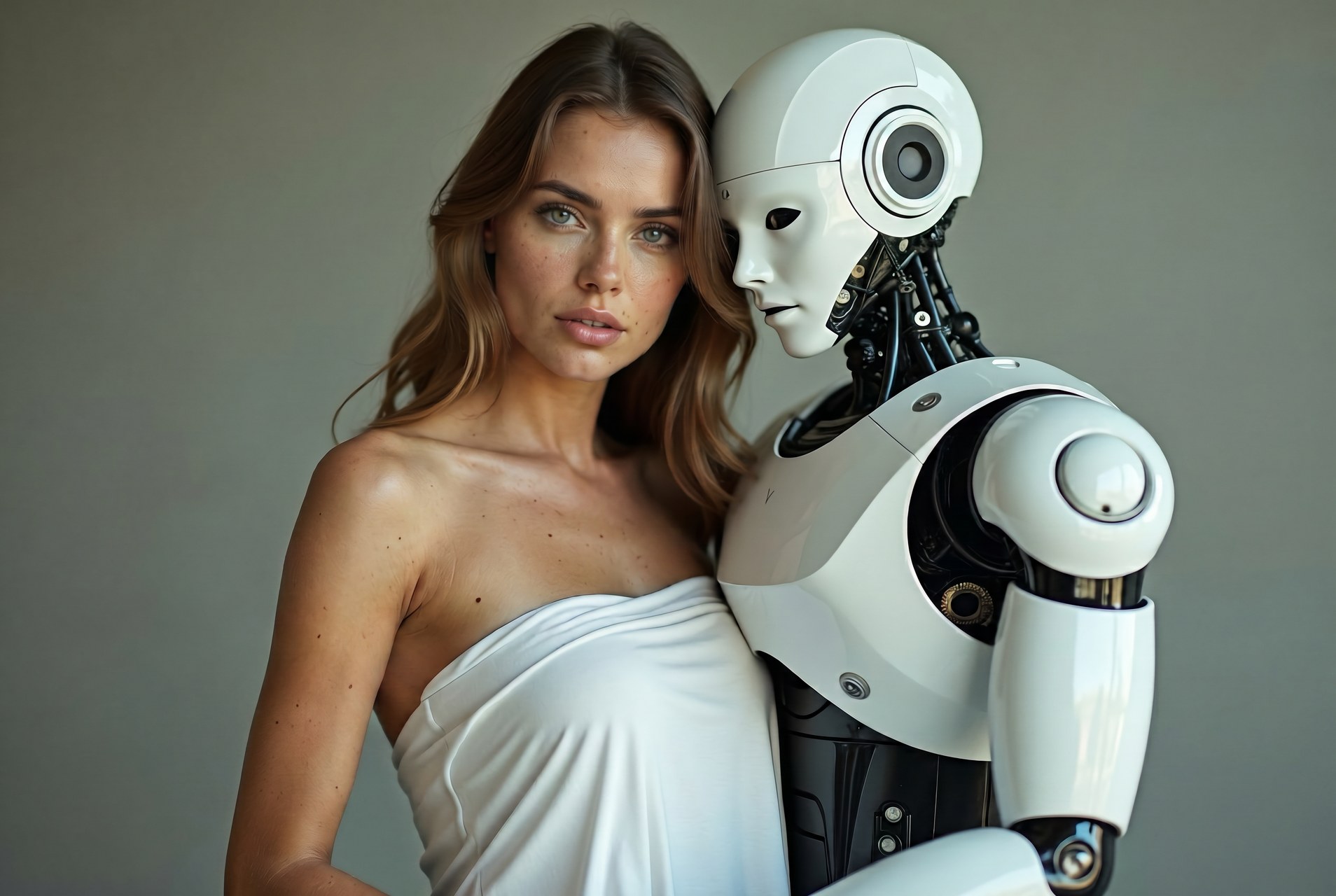
Robot Love: The Future of Human-Machine Relationships
David Levy, a Dutch chess master, posed a provocative thesis to the University of Maastricht in 2007: humans will fall in love with robots, and by 2050 the first human-robot marriage will take place — most likely in Massachusetts, the first U.S. state to legalize same-sex marriage. At the Henn-na Hotel in Nagasaki, Japan — the world’s first hotel staffed primarily by robots — a mechanical dinosaur receptionist greets arrivals with a policy that has become something of a digital-age koan: “Welcome to the Henn-na Hotel. Please don’t ask me any difficult questions, because I am a robot.” It is, without question, the most honest disclosure in hospitality history. Futurist Michael Tchong has made Robot Love the signature topic of his international speaking circuit — a meditation on a future where the line between human and machine intimacy grows as blurred as the line between digital and physical life.
Image courtesy of Michael TchongThe numbers that define the revolution
Digital Lifestyle timeline
Three proofs of the revolution
The Digital Lifestyle Ubertrend is not an abstraction. Its impact registers in the balance sheets of the world’s most valuable companies, in the displacement of entire industries, and in the behavioral data of billions of daily users.
The Amazon Factor
As of May 2026, Amazon’s market capitalization reached $2.9 trillion against Walmart’s $959 billion — despite Walmart reporting $713 billion in fiscal 2026 revenues to Amazon’s $743 billion (TTM ended March 2026). Digital-native efficiency commands a valuation premium physical retail cannot match. The Amazon Factor has claimed Bebe, Blockbuster, Borders, Circuit City, Good Guys, RadioShack, Sears, and Tower Records. By 2035, more than 40 percent of U.S. retail sales — over $2 trillion — will flow through online channels.
AI Supremacy
IBM Deep Blue’s 1997 chess victory over Kasparov was a milestone. DeepMind’s AlphaGo defeating Lee Se-dol at Go in 2016 — a game with more board positions than atoms in the observable universe — was a revolution. ChatGPT’s 100-million-user milestone in 60 days in 2022 was the democratization of that revolution; by 2026, ChatGPT had surpassed 700 million weekly active users. PricewaterhouseCoopers estimates that by the early 2030s, 38 percent of U.S. jobs could be at high risk of automation.
Videogame Hegemony
Grand Theft Auto V generated $816 million in its first 24 hours — surpassing records set by The Avengers and Avatar. The Top 40 videogame-based films have collectively earned $5.3 billion in box office revenues. The gaming market reached $197 billion in 2025 — larger than the global film and music industries combined — with 2.3 billion players worldwide (Newzoo).
The Robot Love paradox
Amid the Digital Lifestyle’s relentless acceleration of human capability and connection, a countervailing force has emerged: as machines become more human, humans are becoming more mechanical in their patterns of behavior, attention, and emotional availability. This is the Robot Love Paradox.
The wearable technology revolution has created what cultural theorists call the “quantified self” — individuals who track heart rate variability, sleep architecture, and caloric intake with the precision previously reserved for laboratory subjects. Tumblr founder David Karp’s 2010 announcement that he planned to wear Fitbits during sex “to graph our physical exertion” was not a curiosity but a manifesto. The human body had become a data source. The Fitbit Tracker, launched September 2008, spawned an industry: IDC estimated 538 million wearable-device shipments in 2024, with 2025 growth moderating to 3.9% as the category matured.
The Apple Watch Series 4, launched September 2018, took this logic to its clinical conclusion. By introducing an FDA-approved ECG monitoring app, Apple transformed a consumer device into a medical instrument. When Ed Dentel, a 46-year-old communications consultant in Richmond, Virginia, updated his Watch on the evening of December 6, 2018, it immediately detected atrial fibrillation. His doctor’s verdict: “This thing may have just saved your life.”
Meanwhile, industrial robots are reshaping the economy with asymmetric logic of their own. Amazon has deployed more than 1 million robots across its global operations network since 2012. Installing Kiva systems in 100 distribution centers would save the company an estimated $2.5 billion in operating costs, according to Deutsche Bank. The McKinsey Global Institute predicts a 30 percent decline in food service and lodging jobs between 2016 and 2030. David Levy’s prediction — that humans will marry robots by 2050 — grows less implausible with every passing quarter.
The costs of the digital civilization
Every Ubertrend generates its own opposition. The Digital Lifestyle is the most powerful force in contemporary civilization — and it carries commensurate risks. Four counter-forces demand particular attention for their scale and structural nature.
Counter-Force 01
Cyber warfare
On April 27, 2007, Estonia became the first nation-state to suffer a coordinated cyberattack when a Russian-linked botnet disabled banks, media outlets, and government communications. Defense minister Jaak Aaviksoo: “It was the first time that a botnet threatened the national security of an entire nation.” The Stuxnet worm — engineered to destroy Iranian uranium centrifuges — became history’s first digital super weapon. The Pentagon faces more than 1 billion cyberattacks annually. Russia’s December 2015 hack of Ukraine’s power grid left 230,000 residents in the dark.
Counter-Force 02
The Retail Apocalypse
The Amazon Factor produced 10,203 store closings in 2017–2018 — nearly double the previous all-time record of 6,163 set during the 2008 financial crisis. Sears, once America’s largest retailer with 1,305 Kmart stores as recently as 2012, collapsed. More than 500 abandoned malls — “grayfields” — now litter the American suburban landscape. A third of consumers say they would rather wash dishes than visit a store. By 2035, more than $2 trillion in U.S. retail sales will move through online channels.
Counter-Force 03
Security Finance Dissonance
The U.S. defense budget request for fiscal 2026 totaled $961 billion — including $113 billion from the 2025 reconciliation act. Cybersecurity startup funding, just $7.6 billion in 2017, has grown substantially as AI-powered threats intensify. Cyber snoopers breached NASA in December 2005; Chinese hackers targeted Adobe, Intel, and Google in January 2010. As Delaware Senator Thomas Carper stated plainly: “The issue of Cyber Warfare is not science fiction anymore. It’s reality.”
Counter-Force 04
Behavioral dependency
The variable-reward architecture of social media platforms produces documented psychological dependency patterns indistinguishable from addictive substances. The U.S. Surgeon General’s 2023 advisory found that 50 percent of American adults report measurable loneliness, with health risks equivalent to smoking 15 cigarettes per day. In February 2024, Sewell Setzer III, 14, died by suicide after forming a deep attachment to a Character.AI chatbot — raising fundamental questions about the duty of care owed by digital platforms to vulnerable users.
The decade ahead
The Digital Lifestyle Ubertrend shows no signs of plateauing. Five trajectories are likely to define its next chapter.
Embodied AI. Generative artificial intelligence — which reached 100 million users in 60 days with ChatGPT, and surpassed 700 million weekly active users by 2026 — is migrating from text interfaces into physical robots, medical devices, and ambient computing environments. Tesla’s Optimus, Figure 01, and Boston Dynamics’ Atlas represent a new generation of AI-powered physical agents capable of performing manual labor previously considered irreducibly human. PricewaterhouseCoopers estimates that 38 percent of U.S. jobs could be at high risk of automation by the early 2030s.
Digital Health. The Apple Watch ECG represents a first step toward the consumerization of clinical healthcare. Continuous biometric monitoring combined with AI diagnostic models trained on millions of patient records will fundamentally transform preventive medicine. Chips embedded under the skin, continuous glucose monitors, and smart fabrics that measure physiological stress are already in development or early deployment.
The Blockchain Economy. Despite Bitcoin’s price volatility, the underlying blockchain infrastructure is reshaping financial services, supply chain management, healthcare records, and digital identity systems. With 55 percent of large corporations already monitoring, researching, or deploying blockchain solutions (International Securities Association), the technology’s potential to disintermediate banks, insurers, and registrars represents one of the most consequential financial innovations since the double-entry ledger.
Spatial Computing. Virtual reality — a $13 billion market in 2025, projected to reach $41 billion by 2031 (Mordor Intelligence) — and augmented reality are converging toward what Apple calls “spatial computing.” The Apple Vision Pro, launched February 2024 at $3,499, represents the first generation of a device category that may prove as transformative as the smartphone. Walmart’s deployment of 17,000 Oculus Go systems across 4,700 U.S. locations for employee training was an early glimpse of VR’s enterprise future.
The Robot Marriage. David Levy’s 2007 prediction — that humans will marry robots by 2050, with Massachusetts leading the legal frontier — remains the most provocative forward implication of the Digital Lifestyle’s trajectory. The Henn-na Hotel’s robotic receptionist has already established a policy for all of this. “Please don’t ask me any difficult questions,” it says, “because I am a robot.” The world is still working out an answer.
Connected Ubertrends
Social media platforms — the dominant infrastructure of the Digital Lifestyle — are simultaneously the primary engine of the surveillance culture Voyeurgasm describes. Every photo posted, every check-in registered, every story shared is a voluntary data point in the largest surveillance apparatus in history.
Amazon’s Prime delivery ecosystem — from two-day to same-day to two-hour — is the most powerful real-world expression of Time Compression. The expectation of instantaneous fulfillment that digital retail created has cascaded through every consumer experience, from food delivery to financial transactions.
The Unwired Ubertrend and the Digital Lifestyle are inseparable. Without Wi-Fi, Bluetooth, and cellular networks, the smartphone is merely a camera. With them, it is the most powerful personal computing device in human history — and the bridge between digital and physical reality.
Sources
- Apple Special Event, San Jose, California, October 23, 2001. (iPod launch and “1,000 songs in your pocket.”)
- Brian Chen, “What’s a CrackBerry?” Wired, 12-Nov-08. (BlackBerry addiction statistics.)
- Dan Herman, “Introducing Short-Term Brands,” Journal of Brand Management, 7(3), 2000. (FOMO coinage.)
- Brendan Sinclair, “Global games market to hit $138 billion this year,” GamesIndustry.biz, 30-Apr-18.
- Kevin Parrish, “America’s First eSports Arena Arrives in Columbus, Ohio,” Tom’s Hardware, 25-Sep-14.
- Dylan Loeb McClain, “First Came Deep Blue, Which Defeated a Chess Champion,” The New York Times, 17-Feb-11.
- Choe Sang-Hun and John Markoff, “Master of Go Board Game Is Walloped by Google Computer Program,” The New York Times, 09-Mar-16.
- Satoshi Nakamoto, “Bitcoin: A Peer-to-Peer Electronic Cash System,” Bitcoin Project, 31-Oct-08.
- Jason Rowley, “ICOs delivered at least 3.5x more capital to blockchain startups than VC since 2017,” TechCrunch, 04-Mar-18.
- Kim Bhasin and Patrick Clark, “How Amazon Triggered a Robot Arms Race,” Bloomberg, 29-Jun-16.
- Chris Isidore, “Jobs are everywhere! Except at stores,” CNNMoney, 05-Jan-18.
- Soo Youn, “An Apple Watch told a 46-year-old man he had an irregular heartbeat; it was right,” ABC News, 11-Dec-18.
- David Levy, Love and Sex With Robots: The Evolution of Human-Robot Relationships, HarperCollins, 2007.
- Joshua Davis, “Hackers Take Down the Most Wired Country in Europe,” Wired, 21-Aug-07. (Estonia cyberattack.)
- Office of the U.S. Surgeon General, “Our Epidemic of Loneliness and Isolation,” May 3, 2023.