Generation X-tasy
Been There, Done That
The Experience Imperative
The experiential Ubertrend warping society’s norms — driven by an easily distracted, “been there, done that” generation that demands ever-more grandiose buildings, ever higher roller coasters, ever larger homes, ever hotter peppers, and ever more extreme everything. Oscar Wilde’s 1893 observation that nothing succeeds like excess has become par for the course.
Nevada, 1931
The Generation X-tasy Ubertrend’s modern arc traces to Thursday, March 19, 1931. The Nevada legislature voted that day to legalize gambling, and the vote went largely unnoticed at the time. It would turn out to be one of the most monumental days in America’s entertainment history.
By the 1950s, Las Vegas’s casinos had become a celebrity magnet. The most influential circle was the Rat Pack — Joey Bishop, Sammy Davis Jr., Dean Martin and Frank Sinatra — who would sing, drink and smoke their way into history, drawing attention to a neon-lit oasis in the desert. It wasn’t until Steve Wynn opened The Mirage on November 22, 1989 that the very definition of experiential entertainment would change forever. Wynn single-handedly put Las Vegas on its current course of palatial excess.
From the dust of the Dunes rose his second oeuvre, the Bellagio, which features a multi-million-dollar art collection, including chandeliers of hand-blown glass by artist Dale Chihuly. Wynn’s mastery of pomp helped Las Vegas become home to seven of the top 10 largest hotels in the world. The world’s largest, The Venetian/Palazzo, boasts a mind-boggling 7,092 rooms. In 2024, Las Vegas drew 41.7 million visitors, supported by nearly 6 million convention delegates and 150,211 hotel rooms (LVCVA).
In 1998, research by the Las Vegas Convention and Visitors Authority discovered that for the first time in its history, the city was perceived by more visitors as an “entertainment” destination (50%) than a “gaming” destination (48%). A survey of 8,000 leisure travelers that year by Plog Research of Reseda, California found that 67% listed shopping as their major activity, while 40% mentioned fine dining. Only 18% were interested in gambling. The rotation was complete: Las Vegas no longer sold gambling. It sold experience.
A coined word, an Oscar Wilde line
“Generation X-tasy” is a portmanteau — Generation X collided with ecstasy, the chemical and the rapture. The phrase compresses a generation (the demographic born roughly 1965–1980, the first cohort raised on cable television and mass-market disposable income) with the experiential thirst that has since spread across every demographic. Millennials, Gen Z and Gen Alpha all inherited the operating system.
The intellectual antecedent is older. In 1893, Oscar Wilde — the Anglo-Irish wit, playwright and aesthete — published the line in A Woman of No Importance: “Nothing succeeds like excess.” Wilde meant it as a joke about Victorian moral arithmetic. The 21st century took it literally. Las Vegas, Dubai, Singapore and now Sphere are operating manuals of the principle.
The dismissive cultural shorthand — “been there, done that” — entered American slang in the 1980s and migrated into operating procedure. The audience grew chronically distracted. The supply side responded with grandiosity. Hair-raising roller coaster rides, leaps off tall buildings, skydiving. Movies with brutally explicit violence or nerve-wracking car chase scenes. Restaurants with outrageous decor or beguiling staff. A $190 Wagyu beef burger laden with truffles. Generation X-tasy brings thrilling new experiences to the easily distracted masses. The masters of experience are ready for the challenge.
The experience economy
They stand in long lines eager to gain entry into one of the city’s celebrated nightclubs. Once they slip by the over-sized, 350-pound bouncers, they line up again at the bar, where they wait three-deep for a chance to scream their orders to bartenders making hundreds of $18 cocktails hourly. Welcome to Tao Las Vegas. Welcome to Generation X-tasy.
The economic rotation is documented. In 1990, 61% of Las Vegas revenues came from its casinos. By 2024, gaming represented only 34.5% of total revenue at the average big Strip casino, with rooms, food, beverage, and entertainment accounting for the remaining 65.4% (UNLV Center for Gaming Research). Tao Asian Bistro, the restaurant that funnels dinner guests into the Venetian Hotel’s Tao nightclub, generates some $65 million in revenues each year — the highest grossing independent restaurant in America when converted-into-nightclub venues are counted.
The truly astonishing figures live in the clubs. XS Nightclub, which Steve Wynn opened at his Encore hotel property in 2008, secured the top spot on the annual Nightclub & Bar Top 100 list for three consecutive years after generating about $105 million in 2014. Hakkasan at the MGM Grand ranked second at $103 million. Marquee at the Cosmopolitan placed third at $85 million. Together, the top 10 generate some $500 million in annual revenues. Hakkasan Group lavished $200 million in partnership with MGM Grand on its namesake restaurant and nightclub alone.
The square-footage arms race has tracked the revenue race. The Palms ignited the megaclub trend with the 26,000-square-feet Rain in 2001. Caesars Palace followed with 36,000-square-feet Pure in 2004. Wynn Resorts’ XS came in at 40,000 square feet. The Cosmopolitan one-upped that in 2010 with 60,000-square-feet Marquee, only to be upstaged by Hakkasan, which debuted on April 18, 2013, with an 80,000-square-feet facility. The meteoric rise of the megaclub turned superstar DJs into “electronic cash kings,” with Scottish DJ Calvin Harris alone earning $63 million between June 2015 and June 2016 — more than $400,000 per Las Vegas gig at Hakkasan.
Four engines of excess
Four engines drive the Generation X-tasy flywheel — each one measurable, each one accelerating since the 1990s. Megavenues run an industrial-scale spectacle business; architectural one-upmanship gets bigger every quarter; the boutique-hotel and design-led hospitality sector segments luxury into ever finer niches; and the consumption arms race extends from $250 million homes to $62,000 lipsticks to peppers hot enough to require a medical waiver. The audience never stops wanting more.
Driver 01
Megavenue scale
Las Vegas’s top 10 nightclubs gross $500M annually. Sphere Las Vegas opened September 29, 2023 with U2’s 25-show UV residency — a $2.3 billion venue with a 160,000-square-foot 16K interior screen and capacity of up to 20,000 (18,600 permanent seats). Sphere generated more than $500 million in revenue in the first nine months of 2025. At its peak, Cirque du Soleil ran seven concurrent Las Vegas productions.
Driver 02
Architectural one-upmanship
Burj Khalifa tops 2,717 ft (828 m) and 160 floors. Dubai’s Palm Jumeirah is a 28-hotel artificial island. Singapore’s Marina Bay Sands debuted at about $6 billion in 2010 — then the world’s most expensive standalone casino property. The Sphere is now the most expensive entertainment venue ever built in Las Vegas, eclipsing the roughly $2 billion Allegiant Stadium.
Driver 03
Design-led hospitality
When Ian Schrager and Steve Rubell opened Morgans on Madison Avenue in 1984 with French designer Andrée Putman, they invented the boutique hotel. By 2003 Smith Travel had tallied 213 U.S. design properties. Today Sheraton’s Aloft, Hilton’s Canopy, Hyatt Centric, Marriott AC and EDITION, plus countless independents, all run on the same operating model: smaller rooms, sophisticated design, active public spaces.
Driver 04
Consumption arms race
The broader U.S. sauces and condiments market scaled to roughly $16 billion by 2020; hot sauce specifically reached about $1 billion (Fortune Business Insights, 2026). Tabasco Scorpion Sauce is 20× hotter than the original. The Carolina Reaper hits 2.2 million Scoville Heat Units. 32% of U.S. adults have at least one tattoo (Pew, 2023), including 41% of adults ages 18–29 and 46% of adults ages 30–49, up from roughly 1% in the 1970s. Boutique luxury extends to a $62,000 KissKiss Gold & Diamonds lipstick from Guerlain and a $190 Wagyu Burger King.
The bartender becomes a mixologist
The experiential tentacles of the clubbing culture extend far beyond Las Vegas. The trend has given rise to such specialized terminology as “turntablist” for the DJ and “mixologist” for the bartender. Gone are the days when bartending and drinking cocktails were formal affairs — the cocktail that cost just 90 cents at San Francisco’s Tadich Grill in 1976 now goes for 10 times that. Traditional drinking establishments have been hit hard. In Chicago, taverns, once popular neighborhood watering holes, have plummeted from 7,000 in 1947 to less than 1,321 today. The absence of Millennials and Gen-Z is a contributing factor; the rotation of preferred spirits matters too. Vodka surpassed whiskey as the country’s biggest-selling spirit by 1976; Gallup reports 26% of consumers now name liquor as their beverage of choice — the highest in 25 years of tracking.
In 1984, in a small village in Québec called Baie-Saint-Paul, two street performers, Guy Laliberté and Gilles Ste-Croix, put the finishing touches on a modest new venture, Cirque du Soleil. Neither could ever have imagined that Generation X-tasy would one day make Cirque the world’s largest theatrical producer. At the height of its Las Vegas dominance, Cirque du Soleil ran as many as seven concurrent productions in the city. The first Cirque production in Las Vegas, Mystère, debuted on December 25, 1993 at the then-Wynn-owned Treasure Island. The Bellagio’s O required a $70 million aquatic theater. New York-New York spent $66 million on Zumanity. At the MGM Grand, Kà — which opened November 26, 2004 — reportedly spent $220 million, including $30 million for costumes and $135 million for the theater. It remains the largest and most expensive production Cirque du Soleil has ever created.
The same logic colonized cuisine. Concept restaurants — Taipei’s Modern Toilet Restaurant, Amsterdam’s supperclub, Las Vegas’s Ku Noodle with its see-through kitchen — have proliferated globally. Rainforest Cafe first opened in the Mall of America on February 3, 1994; Planet Hollywood debuted in New York City in October 1991 with the backing of Sylvester Stallone, Bruce Willis, Demi Moore and Arnold Schwarzenegger. The food is rarely the point. The point is the room.
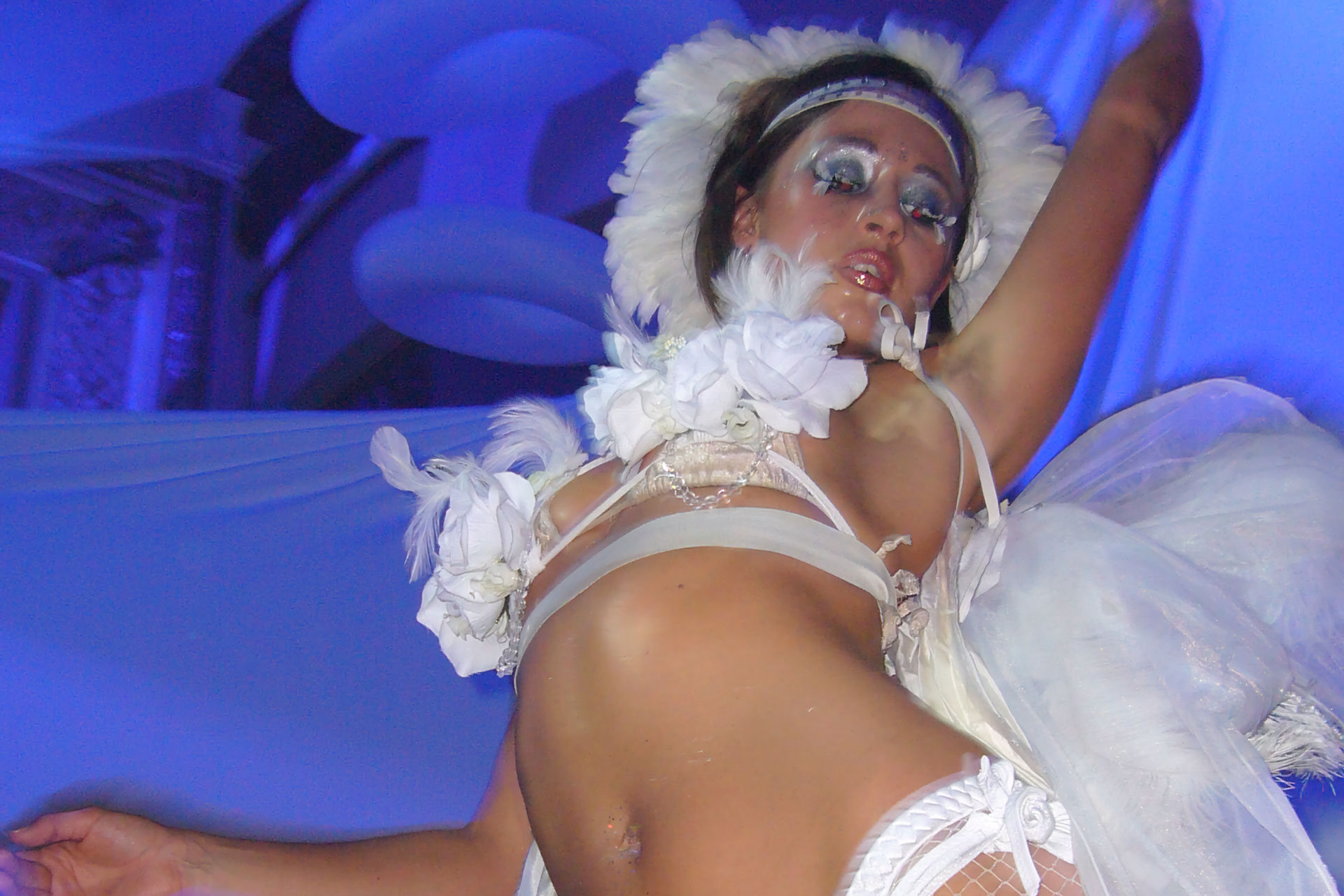
White Party 2006: Ruby Skye, San Francisco
A go-go dancer in feathered white headdress and silver eye makeup performs under cobalt-blue lighting at Ruby Skye’s recurring White Party — one of San Francisco’s signature nightlife rituals from the venue’s late-1990s heyday through its 2018 closure. The scene captures Generation X-tasy at its theatrical mid-decade peak: clubs no longer just sold drinks; they sold immersive spectacle. Within two years, the formula would migrate to Las Vegas, where Wynn’s XS Nightclub became the first single venue to gross more than $100 million annually.
Photo of “White Party” at Ruby Skye dance club in San Francisco on Jun. 16, 2006 by Michael TchongFive numbers that frame the excess
combined 2014 annual revenue of Las Vegas’s top 10 nightclubs, when XS and Hakkasan each cleared ~$100M+
cost to build Sphere Las Vegas, which opened September 29, 2023 with a 25-show U2 residency
of U.S. adults have at least one tattoo (Pew, 2023) — 41% of 18–29-year-olds, 46% of 30–49-year-olds, up from ~1% in the 1970s
U.S. states (plus D.C.) have legalized recreational cannabis as of 2024, up from 10 in 2019
asking price for 924 Bel Air Road (2017) — ultimately sold for $94M in 2019; The One listed at $500M, sold for $126M in 2022
A timeline arc
Oscar Wilde publishes A Woman of No Importance with the line: “Nothing succeeds like excess.”
March 19 — Nevada legislature legalizes gambling. The first dominoes of the experience economy fall.
Wernard Bruining opens Mellow Yellow, the world’s first coffeeshop, at Weesperzijde 53 in Amsterdam.
Steve Rubell and Ian Schrager open Morgans Hotel on Madison Avenue, inventing the boutique hotel. Guy Laliberté and Gilles Ste-Croix found Cirque du Soleil in Baie-Saint-Paul, Québec.
Steve Wynn opens The Mirage on November 22, 1989 — the moment Las Vegas turns from gambling town to entertainment capital.
Feb 14 — Foxwoods opens in Connecticut as the first tribal casino. Within years, 39 states will permit some form of casino gaming.
The Palms opens Rain Nightclub (26,000 sq ft), igniting the Las Vegas megaclub arms race.
Macau surpasses Las Vegas in gambling revenue at $6.95B — the global crown moves east.
Steve Wynn opens XS Nightclub at Encore. By 2014 it is the first single venue to gross more than $100 million annually.
Singapore opens Marina Bay Sands at about $6 billion — the world’s most expensive standalone casino property at the time.
Colorado and Washington legalize recreational cannabis — the first U.S. states to do so.
April 18 — Hakkasan opens at MGM Grand at 80,000 sq ft. Macau gambling peaks at $45 billion (up 4,300% from 2001).
May 14 — U.S. Supreme Court strikes down PASPA in Murphy v. NCAA, opening the floodgates to state-by-state sports-betting legalization.
September 29 — Sphere Las Vegas opens with U2’s UV residency — $2.3 billion, 18,600 permanent seats, world’s largest 16K wraparound LED.
24 U.S. states plus D.C. have now legalized recreational cannabis. 54% of Americans live in a recreational-legal state.
The evidence base
Generation X-tasy is not a single market. It is the convergence of three forces — nightlife at scale, architectural extremism and consumption excess — each measurable, each on its own price curve, each fed by an audience that doesn’t look down. The numbers are large and they are accelerating.
Nightlife at scale is the engine. From the Palms’ 26,000 square feet in 2001 to Hakkasan’s 80,000 in 2013 to Sphere’s 18,600 permanent seats in 2023, the venues kept getting bigger and the revenue per venue followed. Top 20 nightclubs alone generated roughly $1 billion in 2014 ticket and bottle-service revenue; the DJ economy that supports them turned Forbes’s “electronic cash kings” into eight-figure-per-year individual brands.
Architectural extremism is the second force. Dubai built what amounts to the world’s largest oil-fueled mirage in the middle of the desert: the Burj Khalifa at 2,717 feet, the Palm Jumeirah artificial island, the Burj Al Arab hotel, Ski Dubai’s 22,500-square-meter indoor ski resort, the Dubai Mall with 1,200 retail outlets. The 2009 financial crisis required Abu Dhabi to bail Dubai out with $20 billion. Generation X-tasy kept pushing anyway.
Consumption excess is the third. The U.S. hot pepper / hot sauce market scaled from $12 billion in 2014 to $16 billion by 2020. The Carolina Reaper, created by PuckerButt Pepper Co.’s Ed Currie, registers 2.2 million on the Scoville scale; Blair’s 16 Million Reserve sells in 1-milliliter vials. 924 Bel Air Road listed at $250 million in 2017 — and ultimately sold for $94 million in 2019. “The One,” also in Bel Air, launched at $500 million and sold at auction in 2022 for $126 million (about $141 million with fees). The luxury market discovered there is a ceiling after all. The luxury market discovered there is no upper bound on what the 0.01% will pay for an experience.
Top 10 Las Vegas nightclubs gross $500 million a year.
XS Nightclub (~$105M in 2014), Hakkasan at MGM Grand ($103M), Marquee at Cosmopolitan ($85M) — plus the 80,000-square-foot footprint of the megaclub format. Wynn Resorts now operates three of the top 20 venues, with Surrender, Intrigue and XS in the same property cluster.
Dubai built the world’s tallest mirage.
Burj Khalifa: 2,717 ft, 160 floors. Palm Jumeirah: 28 hotels on an artificial island. Sphere Las Vegas: $2.3B, 366 ft tall, 516 ft wide. Marina Bay Sands: about $6B for a boat on top of three towers. The skyline has become a battleground.
From $0.90 cocktails to $62,000 lipsticks in 50 years.
U.S. sauces and condiments market: roughly $16B by 2020. Tattoos: 32% of U.S. adults, 46% of adults ages 30–49 (Pew, 2023). KissKiss Gold & Diamonds lipstick: $62,000. Koenigsegg CCXR Trevita: $4.8 million. Leonardo da Vinci’s Salvator Mundi: $450M (Saudi prince, 2017). Picasso’s Les Femmes d’Alger: $179M (2015).
When the bill comes due
Generation X-tasy’s payoff is real. So is its cost. The most visible casualty has been the spring break economy in the U.S. Sun Belt. After a video of a rape that took place on Panama City Beach went viral in 2015, the city council voted to ban alcohol consumption on the beach during March. Bookings dropped as much as 90% in 2016. Fort Lauderdale, once popularly known as “Fort Liquordale,” had run its own crackdown three decades earlier. Daytona Beach followed. Cancun is now a fading port of call. The economy that ran on 11.3 million U.S. college students — 31% of them using student loan money to fund their trip — has been steadily downsized by the cities that hosted it.
The bodily costs have tracked the financial ones. Cheerleading injuries have more than doubled since the early 1990s, with the National Center for Catastrophic Sports Injury Research ranking cheerleading first among female sports for catastrophic injuries. Cirque du Soleil’s 30-year safety streak ended on June 29, 2013, when French aerialist Sarah Guyard-Guillot fell to her death during a performance of Kà at the MGM Grand. In November 2016, co-founder Gilles Ste-Croix’s son Olivier Rochette was killed by a telescopic aerial platform in San Francisco. The bigger the spectacle, the bigger the risk.
Even the gambling crown has not held steady. Macau’s 2013 peak of $45 billion in gaming revenue collapsed 27% to $33 billion by 2017, the casualty of a Chinese government anti-corruption campaign. The market recovered to about $31 billion in gross gaming revenue in 2025 — the highest post-pandemic total but still below the pre-corruption-crackdown peak. Hamburg’s Reeperbahn — once Europe’s sex-trade engine — saw its iconic Eros Center close in 1988 due to AIDS, and its oldest brothel, the Hotel Luxor, close in April 2008. Owner Waltraud Mehrer specifically cited the rise of surveillance cameras in nearby dance clubs (the Voyeurgasm Ubertrend) as scaring off customers. Generation X-tasy’s tailwinds also create headwinds.
And the financial bill is not always paid by the buyer. Dubai required a $20 billion Abu Dhabi bailout in 2009. The $200,000 cryogenic-grade John Walker bottle, the $80,000 audio cables, the $190 Wagyu burger — these are leading indicators of asset bubbles as much as they are of consumer preference. Bell’s curve catches up.
The pushback
Generation X-tasy has triggered the same pattern as every Ubertrend before it. As one mode of excess scales, the regulatory, legal and demographic pushback scales with it.
Municipal pushback has been the most visible counter-force. The 2015 Panama City Beach alcohol ban on the sand. Fort Lauderdale’s mid-1980s crackdown. Daytona Beach’s late-1990s alcohol ban. Apple’s ban on selfie sticks at WWDC 2015 (cf. Voyeurgasm). Las Vegas itself has felt the chill: traditional neighborhood watering holes in Chicago plummeted from 7,000 in 1947 to 1,321 today, with the absence of Millennials and Gen Z noted as a contributing factor. The 2020 COVID closures swept the rest aside temporarily; recovery has been uneven.
National-scale pushback has come from the Chinese anti-corruption campaign that cratered Macau gaming revenue 27% between 2013 and 2017. Other sovereign pressure has shaped the European nightlife industry, German prostitution law, and global responses to gambling addiction. The opening of Murphy v. NCAA in May 2018 ironically had the opposite valence: by striking down PASPA, the U.S. Supreme Court accelerated sports-betting legalization in 38 states and Washington, D.C., putting the experience economy on a fresh growth curve.
Demographic pushback has been quieter but more lasting. Millennials and Gen Z drink less alcohol than prior cohorts at the same age. Recreational cannabis use rose alongside — the chapter’s 2019 count of 10 states is now 24 states plus D.C., with 54% of Americans living in a recreational-legal state. Joe Francis (Girls Gone Wild) served prison time for his exploits with intoxicated young women. The Ubertrend hasn’t stopped. It has just migrated to substances and platforms the previous generation regarded as taboo. Bob Dylan was right: the times they are a-changin’.
After the Sphere
The next decade of Generation X-tasy will play out along three vectors that the 2019 chapter could only gesture toward.
First, immersive entertainment has been operationalized. Sphere Las Vegas opened on September 29, 2023 with U2 and is now booking residencies and the immersive Darren Aronofsky film Postcard From Earth. The format — wraparound 16K LED at 268 million pixels and a 1,600-speaker Holoplot system — is being copied internationally. The 2024 announcement of a Sphere in Abu Dhabi confirms the export model. The chapter’s prediction that “ever more grandiose buildings, ever higher roller coasters, ever larger homes” would compound has been validated at scale.
Second, legal sports betting has rewritten the U.S. consumer-spend map. Since Murphy v. NCAA in May 2018, 38 states and Washington, D.C. have legalized some form of sports wagering (AGA). DraftKings and FanDuel have built into a duopoly worth tens of billions. The casino industry’s rotation from Las Vegas to mobile is the most consequential Generation X-tasy shift since the post-Mirage entertainment pivot. Nevada is no longer the only ring.
Third, the cannabis legalization wave has matured from boutique to retail. Pew Research reports that 74% of Americans live in a state where cannabis is legal in some form; 79% live in a county with at least one dispensary. Federal rescheduling discussions are ongoing. Adjacent decriminalization waves — psychedelics (Oregon Measure 109, Colorado Proposition 122) — suggest the trend will continue.
The masters of experience have not run out of imagination. They have a $2.3 billion proof-of-concept and an audience that hasn’t found a ceiling. As an anything-goes generation waits in the wings to put its tramp stamp on the future, expect vice habits to morph in all directions, as gambling, sex, drugs and rock ‘n’ roll explode in a firework of new and uncharted experiences. Been there, done that. On to the next.
Where Generation X-tasy intersects
Surveillance cameras in clubs scaring off the very audience the megaclubs were built to host. The same lens that records the spectacle also constrains it.
The aesthetic-procedure boom shares Generation X-tasy’s grammar of excess: more, bigger, longer-lasting, more visible. The body is the venue.
Women now drive 80% of consumer decisions — the dominant force in the luxury, hospitality and aesthetic markets where Generation X-tasy is monetized.
Selected sources
- Michael Tchong, Ubertrends — How Trends and Innovation Are Transforming Our Future, Chapter 3: Generation X-tasy (2019). The canonical source for this entry; original chapter footnotes carry through to inline citations above.
- Sam Ro, “Las Vegas Hasn’t Been About Gambling Since 1999,” Business Insider (March 8, 2013).
- “Nightclub & Bar Releases 2014 Top 100 List,” Nightclub & Bar (February 5, 2015).
- Robin Leach, “Hakkasan, the new ‘king of clubs’ at nearly $200 million, opens at MGM Grand,” Las Vegas Sun (April 18, 2013).
- Zack O’Malley Greenburg, “World’s Highest-Paid DJs 2016: Electronic Cash Kings,” Forbes (August 16, 2016).
- Carolyn Giardina, “Sphere Las Vegas Opens With U2’s Dazzling Musical and Visual Odyssey,” The Hollywood Reporter (September 30, 2023).
- Athena Chapekis, “Most Americans now live in a legal marijuana state, have a cannabis dispensary in their county,” Pew Research Center (February 29, 2024).
- U.S. Supreme Court, Murphy v. National Collegiate Athletic Association, 584 U.S. ___ (May 14, 2018). Struck down PASPA.
- Dean Schabner, “Cirque du Soleil Performer Killed in Fall During Las Vegas Performance,” ABC News (June 30, 2013). On Sarah Guyard-Guillot.
- Bill Pennington, “As Cheerleaders Soar Higher, So Does the Danger,” The New York Times (March 31, 2007).
- Howard Stutz, “Macau’s 34.3% decline in 2015 was just the beginning,” Las Vegas Review-Journal (January 5, 2016).
- Connor Sheets, “Panama City Beach’s Spring Break is ‘dead’ as beach drinking ban drives partiers away,” AL.com (March 17, 2016).
- Robert Frank, “By 2020, half the world’s wealth will be controlled by millionaires,” CNBC (June 7, 2016).
- “Nevada legalizes gambling,” History.com. On March 19, 1931.
- “Sphere (venue),” Wikipedia. $2.3B Las Vegas immersive venue; 18,600 permanent seats; opened September 29, 2023.